
An evolutionary story written in Pakistani rock
The origin of whales was, for a long time, one of the great gaps in the fossil record. Living whales are so thoroughly adapted to the sea that their land-living ancestry was hard to trace. That changed largely because of the Eocene rocks of Pakistan, which turned out to preserve a remarkable series of intermediate forms — animals caught, in successive layers, at different stages of the move from land to water.
These fossils come from the shallow-marine and coastal deposits laid down along the northern margin of the Indian plate as it closed on Asia. Reading them in order is like watching legs shorten, bodies streamline and ears re-tune to hear underwater.
Pakicetus: a whale that walked
The earliest of the group, Pakicetus, came from the Kuldana Formation of northern Punjab, in rocks roughly fifty million years old. It looked nothing like a modern whale — a wolf-sized, four-legged animal that lived in and around fresh water. What marked it as a whale relative was hidden in its skull: the distinctive structure of the ear region, a signature that ties it unambiguously to cetaceans.
Pakicetus showed that whales began not as swimmers but as land animals that waded and hunted at the water’s edge.
Ambulocetus: the walking, swimming whale
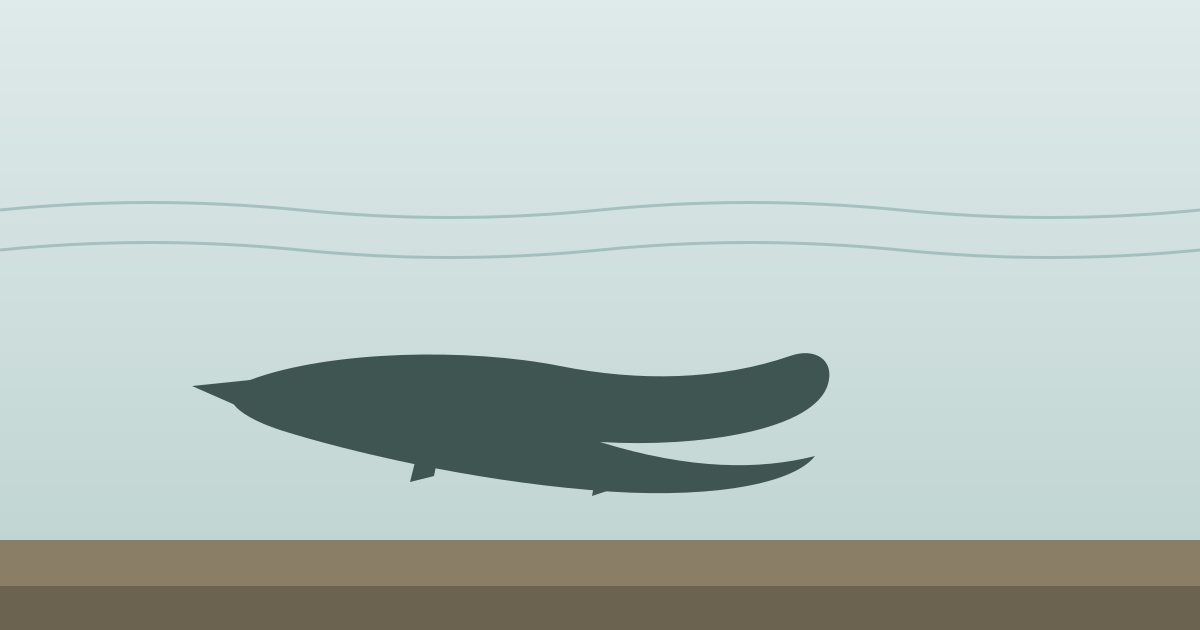
From the same Kuldana Formation came Ambulocetus natans — the name means “walking whale that swims.” With large hind feet and a powerful tail, it was built for an amphibious life like a modern otter or crocodile, propelling itself through coastal shallows while still able to move on land. It is one of the clearest transitional fossils known for any group of animals.
Rodhocetus and the move offshore
A little younger, in the Domanda Formation of Balochistan, Rodhocetus shows the next step: a more fully marine animal with shortened limbs and a body better suited to sustained swimming. Crucially, the ankle bones of these early whales settled a long-standing question about their ancestry — their distinctive shape links whales firmly to the artiodactyls, the even-toed hoofed mammals that include hippos, the whales’ closest living relatives.
Why Pakistan preserved the sequence
This was not luck alone. The right rocks were in the right place: warm, shallow Tethyan waters and river deltas along a subsiding margin buried carcasses quickly and often, and later uplift during the collision that built the mountains brought those beds back to the surface where they could be found and mapped. The result is a stratigraphic archive of an evolutionary transition that few other regions can match.
Together with the Miocene Siwalik mammals of the Potwar, these Eocene whales give Pakistan a fossil record that documents both the birth of whales and the rise of apes.
Browse the fossils recorded across the dataset on the fossils page, or see how index fossils are used to date rock in the dating tool.